

Chapter 12. विद्युत Class 10 Science CBSE notes in hindi ओम का नियम (Ohms Law) - CBSE Study
कक्षा 10 Science के लिए NCERT समाधान नवीनतम CBSE पाठ्यक्रम और NCERT पाठ्यपुस्तकों के अनुसार सावधानीपूर्वक तैयार किए गए हैं, ताकि विद्यार्थी प्रत्येक अवधारणा को स्पष्ट रूप से समझ सकें। इन समाधानों में सभी महत्वपूर्ण 12. विद्युत को विस्तृत व्याख्या और चरण-दर-चरण उत्तरों सहित शामिल किया गया है, जिससे परीक्षा की बेहतर तैयारी हो सके। प्रत्येक ओम का नियम (Ohms Law) को सरल भाषा में समझाया गया है, ताकि विद्यार्थी मूलभूत सिद्धांतों को आसानी से समझकर अपनी शैक्षणिक उपलब्धि में सुधार कर सकें। यह अध्ययन सामग्री दैनिक गृहकार्य, पुनरावृत्ति अभ्यास तथा वार्षिक परीक्षा की तैयारी के लिए विशेष रूप से उपयोगी है। सटीक उत्तर, स्पष्ट अवधारणाएँ और व्यवस्थित सामग्री विद्यार्थियों को आत्मविश्वास बढ़ाने तथा परीक्षाओं में अधिक अंक प्राप्त करने में सहायता करती है। चाहे आप किसी विशेष विषय का पुनरावृत्ति कर रहे हों या पूरे अध्याय की तैयारी कर रहे हों, यह संसाधन Science में पूर्ण सफलता के लिए विश्वसनीय और पाठ्यक्रम-आधारित मार्गदर्शन प्रदान करता है।
CBSE NOTES:
Class 10 English Medium Science All Chapters:
12. विद्युत
3. ओम का नियम (Ohms Law)
ओम का नियम (Ohm's Law):
"किसी धातु के तार में प्रवाहित होने वाली विद्युत धारा उस तार के सिरों के बीच विभवांतर के अनुक्रमानुपाती होती है, परंतु तार का ताप समान रहना चाहिए। इसे ओम
का नियम कहते हैंं।"
इस नियम के अनुसार,
V ∝ I
or V = RI
इस विभव-धारा ग्राफ को देखिए |

हम देखते हैं कि विभवान्तर बढ़ने के साथ-साथ विद्युत धारा का मान भी बढ़ जाता है और विभवान्तर घटने से धारा भी घट जाता है अर्थात इनमें अनुक्रमानुपातिक संबंध है | इसे ही ओम का नियम कहते है |
प्रतिरोध (Resistance):
प्रतिरोध चालक का वह गुण है जिससे वह अपने से होकर प्रवाहित होने वाले विद्युत धारा के प्रवाह का विरोध करता है | चालक के इस गुण को प्रतिरोध कहते हैं |
ओम के नियम के उपयोग से:
प्रतिरोध = विभवान्तर/धारा

- प्रतिरोध का SI मात्रक Ohm(Ω) है |
- V/I = R, जो कि एक स्थिरांक है |
1 ओम प्रतिरोध (1 Ohm of resistance): if यदि किसी चालक के दोनों सिरों के बीच विभवान्तर 1 V है तथा उससे 1 A विद्युत धारा प्रवाहित होती है, तब उस चालक का प्रतिरोध R, 1 Ω होता है |

- The current through a resistor is inversely proportional to its resistance.
- If the resistance is doubled the current gets halved.
- In many practical cases it is necessary to increase or decrease the current in an electric circuit.
Variable resistance: A component used to regulate current without changing the voltage source is called variable resistance.
Rheostat: It is a device which is often used to change the resistance in the electric circuit.
Resistor: A conductor having some appreciable resistance is called a resistor.
Some points:
- Certain components offer an easy path for the flow of electric current while the others resist the flow.
- motion of electrons in an electric circuit constitutes an electric current.
- The electrons, however, are not completely free to move within a
conductor. - They are restrained by the attraction of the atoms among which they move.
- motion of electrons through a conductor is retarded by its resistance.
Good conductor: A component of a given size that offers a low
resistance is a good conductor.
Poor conductor: A component of identical size that offers a higher resistance is a poor conductor.
Resistance of a conductor depends on followings factors:
(i) On Length of conductor.
(ii) On Area of cross-section of conductor.
(iii) On the nature of conductor's materail.
Relation among Length, Area and Resistance:
Resistance of a uniform metallic conductor is directly proportional to its length (l) and inversely proportional to the area of cross-section (A).
This gives:
R ∝ l .................. (i)
and R ∝ l/A ................... (ii)
R ∝ l/A using (i) and (ii)
or,
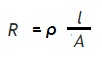
where ρ (rho) is a constant of proportionality and is called the electrical
resistivity of the material of the conductor.
The SI unit of resistivity is Ω m.
Resistivity: Resistivity is a characteristic property of the material. S. I unit of resistivity is ohm (Ω). It is denoted by p.
- The metals and alloys have very low resistivity in the range of 10-8 Ω m to 10-6 Ω m.They are good conductors of electricity.
- Insulators like rubber and glass have resistivity of the order of 1012 to 1017 Ω m.
- Both the resistance and resistivity of a material vary (परिवर्तित) with temperature.
मिश्रधातुओं के गुण (Charactristics of alloy):
(i) एलॉय जिस धातु से बने होते है उन धातुओं की तुलना में उनसे बने मिश्र धातुओं का गलनांक अधिक होता है |
(ii) मिश्रधातु ऊँच तापमान पर भी आसानी से इनका दहन नहीं होता है |
(iii) इनका गलनांक ऊँच होता है |
यही कारण है की मिश्रधातुओं का उपयोग सामान्यत: विद्युत तापक यंत्रों में किया जाता है, जैसे - विद्युत इस्त्री , टोस्टर इत्यादि | विद्युत बल्बों की तंतु के लिए एकमात्र टंगस्टन का ही उपयोग किया जाता है | टंग्स्टन एक मिश्रधातु है जिसका गलनांक बहुत ही ऊँच होता है | जहाँ तांबा और एल्युमीनियम का सामान्य उपयोग विद्युत प्रवाह चालक के रूप में किया जाता है |