

16. Light Class 8 Science [LATEST] Solutions Text Book Exercise in English - CBSE Study
NCERT Solutions for Class 8 Science are carefully prepared according to the latest CBSE syllabus and NCERT textbooks to help students understand every concept clearly. These solutions cover all important 16. Light with detailed explanations and step-by-step answers for better exam preparation. Each Text Book Exercise is explained in simple language so that students can easily grasp the fundamentals and improve their academic performance. The study material is designed to support daily homework, revision practice, and final exam preparation for Class 8 students. With accurate answers, concept clarity, and structured content, these NCERT solutions help learners build confidence and score higher marks in their examinations. Whether you are revising a specific topic or preparing an entire chapter, this resource provides reliable and syllabus-based guidance for complete success in Science.
Class 8 English Medium Science All Chapters:
16. Light
3. Text Book Exercise
Exercise - Question:
Choose the correct option in Questions 7 – 8 7.
Que: Angle of incidence is equal to the angle of reflection
(a) Always
(b) Sometimes
(c) Under special conditions
(d) Never
Ans: (a) Always|
Que: Image formed by a plane mirror is
(a) virtual, behind the mirror and enlarged
(b) virtual, behind the mirror and of the same size as the object
(c) real at the surface of the mirror and enlarged
(d) real, behind the mirror and of the same size as the object.
Ans: (b) virtual, behind the mirror and of the same size as the object|
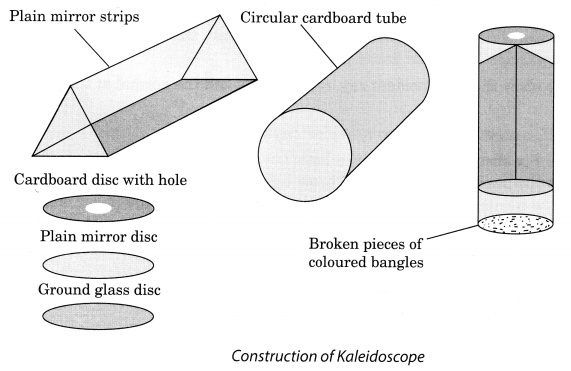
Que: Describe the construction of a kaleidoscope.
Ans: Kaleidoscope is a device based on the principle of multiple reflections. It consists of three long and narrow strips of plane mirrors inclined at an angle of 60° to one another forming prism. This is fitted in a tube. One end of this tube is closed by a cardboard disc having a hole at its centre. To the other end touching the mirrors plane glass plate is fixed on which broken pieces of coloured bangles are placed. This end of the tube is closed by a ground glass plate.
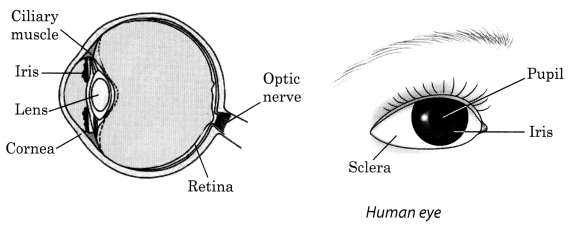
Que: Draw a labeled sketch of the human eye.
Ans:
Que: Gurmit wanted to perform Activity 16.8 using a laser torch. Her teacher advised her not to do so. Can you explain the basis of the teachers advise?
Ans: Teacher has advised Gurmit not to do so because laser light is very harmful for her eyes and can cause a permanent defect in the eye. Person can even lose his or her eyesight if laser torch is directed over the eyes.
Que: Explain how you can take care of your eyes.
Ans: Eyes are very precious. We must take proper care of them. We must
- always sit straight while reading or writing.
- if advised, use suitable spectacles.
- wash our eyes with clean water frequently.
- not look at the sun directly.
- always read or write in a proper light.
Que: What is the angle of incidence of a ray if the reflected ray is at an angle of 90° to the incident ray?
Ans: Here, the angle of reflection is 90°. As we know, according to the laws of reflection that angle of incidence is equal to angle of reflection.
Here, the angle between the incident ray and reflected ray is 90°.
i.e., ∠i + ∠r = 90°
Since, ∠i = ∠r
We can write, ∠i + ∠i = 90°
⇒ 2∠i = 90°
⇒ ∠i = 45°
Angle of incidence = 45°.
Que: How many images of a candle will be formed if it is placed between two parallel plane mirrors separated by 40 cm?
Ans: Here, mirrors are placed parallel to each other 40 cm apart. Therefore, the infinite number of images will be formed.
Que: Two mirrors meet at right angles. A ray of light is incident on one at an angle of 30° as shown in Fig. 16.19. Draw the reflected ray from the second mirror.
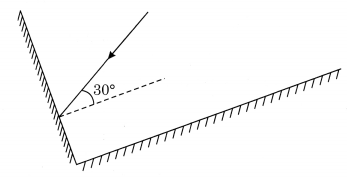
Ans:
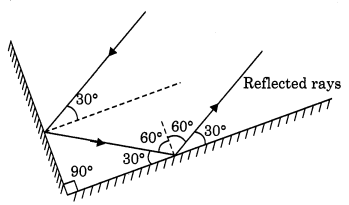
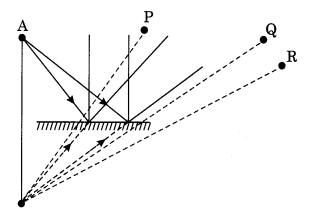
Que: Fig. 16.19 16. Boojho stands at A just on the side of a plane mirror as shown in Fig. 16.20. Can he see himself in the mirror? Also can he see the image of objects situated at P, Q and R? Fig. 16.20
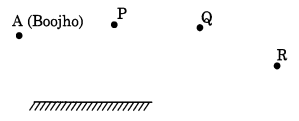
Ans: No, Boojho can’t see himself in the mirror. He can see the image of the object at P and Q but not of R.
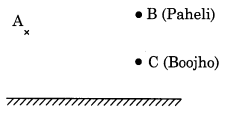
Que: (a) Find out the position of the image of an object situated at A in the plane mirror (Fig. 16.21).
(b) Can Paheli at B see this image?
(c) Can Boojho at C see this image?
(d) When Paheli moves from B to C, where does the image of A move.
Ans: (a) It is shown in the following figure.
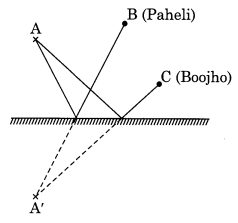
(b) Yes, Paheli can see the image of A.
(c) Yes, Boojho can see the image of A.
(d) Image of the object at A will not move as an object is not moving.
Topic Lists: