

16. Light Class 8 Science [LATEST] Solutions Text Book Exercise in English - CBSE Study
NCERT Solutions for Class 8 Science are carefully prepared according to the latest CBSE syllabus and NCERT textbooks to help students understand every concept clearly. These solutions cover all important 16. Light with detailed explanations and step-by-step answers for better exam preparation. Each Text Book Exercise is explained in simple language so that students can easily grasp the fundamentals and improve their academic performance. The study material is designed to support daily homework, revision practice, and final exam preparation for Class 8 students. With accurate answers, concept clarity, and structured content, these NCERT solutions help learners build confidence and score higher marks in their examinations. Whether you are revising a specific topic or preparing an entire chapter, this resource provides reliable and syllabus-based guidance for complete success in Science.
Class 8 English Medium Science All Chapters:
16. Light
2. Text Book Exercise
Exercise - Question:
Que: Suppose you are in a dark room. Can you see objects in the room? Can you see objects outside the room. Explain.
Ans: When we are in a dark room then we cannot see objects in the room. We can see the objects outside the room, because out of the room the light is available and the rays of light can enter our eyes after reflection from the objects.
Que: Differentiate between regular and diffused reflection. Does diffused reflection mean the failure of the laws of reflection?
Ans:
| Regular Reflection | Diffused Reflection |
| (i) All the reflected rays are parallel. | (i) The reflected rays are not parallel. |
| (ii) It occurs on a smooth and polished surface. | (ii) It occurs on the rough surface. |
| (iii) Reflected rays are in one direction. | (iii) Reflected rays are scattered in different directions. |
No, diffuse reflection doesn’t mean the failure of laws of reflection.
Que: Mention against each of the following whether regular or diffused reflection will take place when a beam of light strikes. Justify your answer in each case.
(a) Polished wooden table
(b) Chalk powder
(c) Cardboard surface
(d) Marble floor with water spread over it
(e) Mirror
(f) Piece of paper
Ans:
1. Regular reflection will take place because the surface is plane and polished.
2. Diffused reflection will take place because the surface is rough.
3. Diffused reflection will take place because the surface is rough.
4. Regular reflection will take place because the surface is smooth and plane.
5. Regular reflection will take place because the surface is plane and polished.
6. Diffused reflection will take place because the surface is rough.
Que: State the laws of reflection.
Ans: The laws of reflections are:
- The incident ray, the normal and the reflected ray, all lie in the same plane.
- The angle of incidence is equal to the angle of reflection.
Que: Describe an activity to show that the incident ray, the reflected ray and the normal at the point of incidence lie in the same plane.
Ans: Activity: To show that the incident ray, reflected ray and the normal at the point of incidence lie in the same plane.
Materials Required: Plane mirror, holder, ray box, etc.
Procedure: Fix sheet of white paper, a little beyond the edge of the board. Place a plane mirror strip vertically to the paper using a stand. Throw light from a ray box on the mirror. Look at the reflected ray. Mark the incident ray, normal ray and reflected ray. Fold the paper which is beyond the edge of the board. You will observe that the reflected ray is not seen in the folded portion of the chart paper. Now bring the folded portion back to its original position. The reflected ray of light is again seen on the page Conclusion: The sheet on the board can be considered as a plane. The incident ray, the reflected ray, the normal at the point of incidence lie in the same plane.
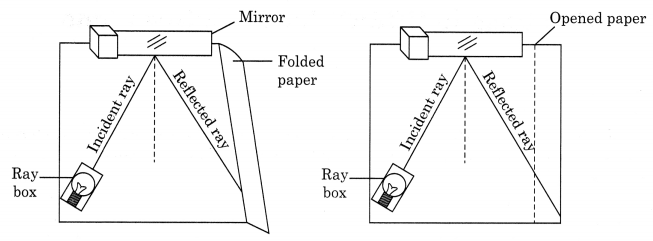
Incident ray, reflected ray and normal at the point of incidence lie in the same plane.
Que: Fill in the blanks in the following:
(a) A person 1 m in front of a plane mirror seems to be _______________ m from his image.
(b) If you touch your ____________ ear with right hand in front of a plane mirror it will be seen in the mirror that your right ear is touched with ____________
(c) The size of the pupil becomes ____________ when you see in dim light.
(d) Night birds have ____________ cones than rods in their eyes.
Ans:
(a) 2
(b) left, left hand
(c) larger
(d) lesser
Topic Lists: