

Orienting Yourself: The Use of Coordinates Class 9 Mathematics Ganita Manjari [LATEST] Solutions Exercise Set 1.1 in English - CBSE Study
NCERT Solutions for Class 9 Mathematics Ganita Manjari are carefully prepared according to the latest CBSE syllabus and NCERT textbooks to help students understand every concept clearly. These solutions cover all important Orienting Yourself: The Use of Coordinates with detailed explanations and step-by-step answers for better exam preparation. Each Exercise Set 1.1 is explained in simple language so that students can easily grasp the fundamentals and improve their academic performance. The study material is designed to support daily homework, revision practice, and final exam preparation for Class 9 students. With accurate answers, concept clarity, and structured content, these NCERT solutions help learners build confidence and score higher marks in their examinations. Whether you are revising a specific topic or preparing an entire chapter, this resource provides reliable and syllabus-based guidance for complete success in Mathematics Ganita Manjari.
Class 9 English Medium Mathematics Ganita Manjari All Chapters:
Orienting Yourself: The Use of Coordinates
1. Exercise Set 1.1
Fig. 1.3 shows Reiaan’s room with points OABC marking its corners. The x- and y-axes are marked in the figure. Point O is the origin.
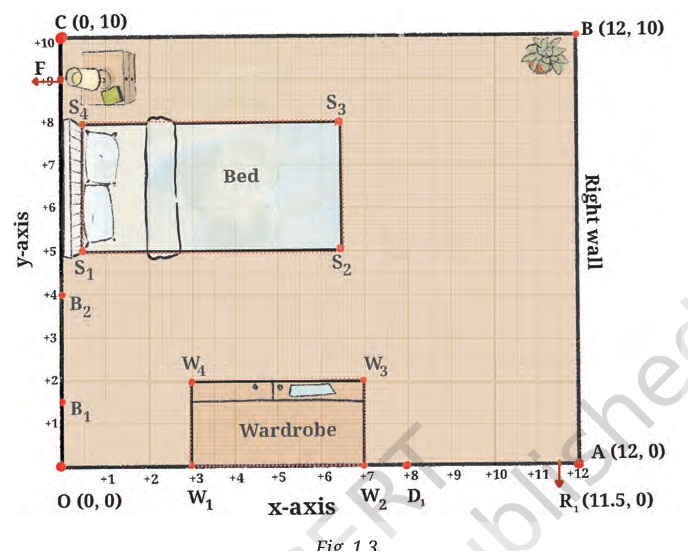
Referring to Fig. 1.3, answer the following questions:
(i) If D1R1 represents the door to Reiaan’s room, how far is the door from the left wall (the y-axis) of the room? How far is the door from the x-axis?
(ii) What are the coordinates of D1?
(iii) If R1 is the point (11.5, 0), how wide is the door? Do you think this is a comfortable width for the room door? If a person in a wheelchair wants to enter the room, will he/she be able to do so easily?
(iv) If B1 (0, 1.5) and B2 (0, 4) represent the ends of the bathroom door, is the bathroom door narrower or wider than the room door?
Solutions:
(i) Given that D₁R₁ is the door. From figure D₁ ≈ (8, 0). Distance from y-axis (left wall) = 8 units. Distance from x-axis = 0 units. So, door is 8 units away from left wall and 0 units from x-axis.
(ii) From observation, D₁ = (8, 0).
(iii) Given R₁ = (11.5, 0) and D₁ = (8, 0). Door width = 11.5 − 8 = 3.5 units (ft). This is a comfortable width. A wheelchair can also pass easily (standard ~3 ft).
(iv) Given B₁ = (0, 1.5) and B₂ = (0, 4). Bathroom door width = 4 − 1.5 = 2.5 ft. Since room door = 3.5 ft and bathroom door = 2.5 ft, the bathroom door is narrower.
Topic Lists: