

1. Crop Production And Management Class 8 Science [LATEST] Solutions Text Book Exercise in English - CBSE Study
NCERT Solutions for Class 8 Science are carefully prepared according to the latest CBSE syllabus and NCERT textbooks to help students understand every concept clearly. These solutions cover all important 1. Crop Production And Management with detailed explanations and step-by-step answers for better exam preparation. Each Text Book Exercise is explained in simple language so that students can easily grasp the fundamentals and improve their academic performance. The study material is designed to support daily homework, revision practice, and final exam preparation for Class 8 students. With accurate answers, concept clarity, and structured content, these NCERT solutions help learners build confidence and score higher marks in their examinations. Whether you are revising a specific topic or preparing an entire chapter, this resource provides reliable and syllabus-based guidance for complete success in Science.
Class 8 English Medium Science All Chapters:
1. Crop Production And Management
2. Text Book Exercise
Text Book Exercise
Que: Select the correct word from the following list and fill in the blanks. float, water, crop, nutrients, preparation
(a) The same kind of plants grown and cultivated on a large scale at a place is called _____________.
(b) The first step before growing crops is _____________ of the soil.
(c) Damaged seeds would _____________ on top of water.
(d) For growing a crop, sufficient sunlight and ________ and ________from the soil are essential.
Ans:
(a) Crops
(b) Preparation of soil.
(c) Float
(d) water, nutrients
Que: Match items in column A with those in column B.
| A | B | |
| (i) | Kharif crops | (a) Food for cattle |
| (ii) | Rabi crops | (b) Urea and super phosphate |
| (iii) | Chemical fertilisers urine and plant waste | (c) Animal excreta, cow dung |
| (iv) | Organic manure |
(d) Wheat, gram, pea (e) Paddy and maize |
Ans:
| A | B | |
| (i) | Kharif crops | (e) Paddy and maize |
| (ii) | Rabi crops | (d) Wheat, gram, pea |
| (a) Food for cattle | ||
| (iii) | Chemical fertilisers |
(b) Urea and super phosphate urine and plant waste |
| (iv) | Organic manure | (c) Animal excreta, cow dung |
Que: Give two examples of each.
(a) Kharif crop
(b) Rabi crop
Ans:
(a) Kharif crop – Paddy and Maize
(b) Rabi crop – Wheat and gram.
Que: Write a paragraph in your own words on each of the following.
(a) Preparation of soil
(b) Sowing
(c) Weeding
(d) Threshing
Ans:
(a) Preparation of soil – The preparation of soil is the first step before growing a crop. One of the most important tasks in agriculture is to turn the soil and loosen it. This allows the roots to penetrate deep into the soil. The process of loosening and turning of the soil is called tilling or ploughing. This is done by using a plough. Ploughs are made of wood or iron. The ploughed field may have big pieces of soil called crumbs. It is necessary to break these crumbs with a plank. The levelling of soil is done with the help of a leveller.
(b) Sowing – Sowing is a process of putting seeds into soil, in this process there is used a traditional funnel. It helps to put seeds into soil. Sowing is the most important part of crop production. Before sowing, good quality seeds are selected. Seed must be at appropriate distance and be avoided overcrowding.
(c) Weeding - Many other undesirable plants may grow naturally along with the crop. These undesirable plants are called weeds. Weeds are harmful for crops. These take all nutrients water and light from soils which are added for crops. Weeds can be removed manually or by using weedicides. Manually there is used a Khurpi while by using weedicides we use chemical substances like 2, 4-D, which damage only weeds and do not harm to crops
(d) Threshing – After harvesting the crops, the crops are threshed for removing grain seeds from the chaff. This is carried out with the help of a machine called ‘combine’ which is in fact a combined harvester and thresher.
Que: Explain how fertilisers are different from manure.
Ans: The substance which are added to the soil in the form of nutrients for the healthy growth of plants are called manure and fertiliers.
Differrence:
| Fertilizer | Manure |
| (i) Fertilizer are prepared in factories. | (i) Manure are prepared in the fields. |
| (ii) Fertilizer no provide humus to the soil. | (ii) Manure provides a lot of humus to the soil. |
| (iii) Fertilizers are very rich in plants. | (iii) Manure are not rich in plants. |
Que: What is irrigation? Describe two methods of irrigation which conserve water.
Ans: The supply of water to crops at differenet intervals is called irritating.
(i) Sprinkler system: This system is more useful on uneven land, having fewer water supplies. In this method, water is supplied using pipes to one or more central locations within the field. When water is allowed to flow under high pressure with the help of a pump, it gets sprinkled on the crops.
b) Drip system: In this system, water is delivered at or near the roots of plants, drop by drop. This is the most efficient method of irrigation as there is no wastage of water at all. This method is important in areas where water availability is poor.
Que: If wheat is sown in kharif season, what would happen? Discuss.
Ans: In kharif season there have lot of rainfall, whereas wheat need winter (cold) so in kharif season not sown wheat.
Que: Explain how soil gets affected by the continuous plantation of crops in a field?
Ans: Continous growing of crops makes the soil deficient in certain nutrients.
Que: What are weeds? How can we control them?
Ans: The undesirable plants in the fields that grow naturaly are called weeds. weeds must be removed,otherwise our own crop plants may not get sufficent water,nutrients,space and lights. so, they are removed either by manual method or by using weedicides.
The manual removal includes physical removal of weeds by uprooting or cutting them close to the ground from time to time. this is done with the help of a khurpi or a harrow. by using weedicides also,we can remove weeds. These weedicides damage only weeds and do not harm crop.
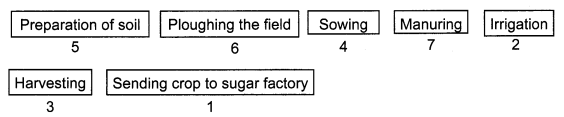
Q10. Arrange the following boxes in proper order to make a flow chart of sugarcane crop production.

Ans:
Topic Lists: