

Chapter 10. Life in the deserts Class 7 Geography [LATEST] Solutions NCERT Exercise in English - CBSE Study
NCERT Solutions for Class 7 Geography are carefully prepared according to the latest CBSE syllabus and NCERT textbooks to help students understand every concept clearly. These solutions cover all important Chapter 10. Life in the deserts with detailed explanations and step-by-step answers for better exam preparation. Each NCERT Exercise is explained in simple language so that students can easily grasp the fundamentals and improve their academic performance. The study material is designed to support daily homework, revision practice, and final exam preparation for Class 7 students. With accurate answers, concept clarity, and structured content, these NCERT solutions help learners build confidence and score higher marks in their examinations. Whether you are revising a specific topic or preparing an entire chapter, this resource provides reliable and syllabus-based guidance for complete success in Geography.
Class 7 English Medium Geography All Chapters:
Chapter 10. Life in the deserts
1. NCERT Exercise
Exercise - Question:
Que: Answer the following questions.
(a) What are the two types of deserts found in the world?
(b) In which continent is the Sahara desert located?
(c) What are the climatic conditions of the Ladakh desert?
(d) What mainly attracts tourists to Ladakh?
(e) What type of clothes the people of the Sahara desert wear?
(f) Name the trees that grow in Ladakh.
Ans:
(a) The two types of deserts found in the world are hot deserts and cold deserts.
(b) The Sahara desert is located in Africa.
(c) The climate of the Ladakh desert is extremely cold and dry due to its high attitude which varies from about 3,000 m in Kargil to more than 8,000 m in the Karakoram. The air at this attitude is so then that the heat of the sun can be felt intensely. The day temperatures in summer are just above zero degree and the night temperatures are below -30°C. Winters are extremely cold with temperatures below -40°C for most of the time. There is very little rainfall in this region. It is as low as 10 cm every year. The area experiences freezing winds and burning hot sunlight. There is always a chance of sunstroke and frostbite at the same time.
(d) Ladakh is a famous tourist place. The tourists from within the country and abroad enjoy visiting Buddhist monasteries that dot the Ladakhi landscape with their traditional gompas.
The meadows and glaciers in Ladakh also attract these tourists. The ceremonies and festivities in which the local people keep themselves engaged during winter months are great attractions to the tourists.
(e) The people of the Sahara desert wear heavy clothes.
(f) Scanty patches of grasses and shrubs, groves of willows and poplars, fruit trees such as apples, apricots and walnuts.
Que: Tick the correct answer.
(i) Sahara is located in which part of Africa
(a) eastern
(b) northern '
(c) western
(ii) Sahara is what type of desert
(a) cold
(b) hot
(c) mild
(iii) The Ladakh desert is mainly inhabited by
(a) Christians and Muslims
(b) Buddhists and Muslims
(c) Christians and Buddhists
(iv) Deserts are characterised by
(a) scanty vegetation
(b) heavy precipitation
(c) low evaporation
(v) Hemis in the Ladakh is a famous
(a) temple
(b) church
(c) monastery
(vi) Egypt is famous for growing
(a) wheat
(b) maize
(c) cotton
Ans:
(i) - (b)
(ii) - (b)
(iii) - (b)
(iv) - (a)
(v) - (c)
(vi) - (c).
Que: Match the following.
(i) Oasis (a) Libya
(ii) Bedouins (b) monastery
(iii) Oil (c) glacier
(iv) Gangri (d) depressions with water
(v) Lamayuru (e) cold desert
(f) Sahara
Ans:
| Column I | Column II |
| (i) Oasis | (d) Depreesor with water |
| (ii) Bedouins | (f) Sahara |
| (iii) Oil | (a) Libya |
| (iv) Gangri | (c) Glacier |
| (v) Lamayuru | (b) Monastery. |
Que: Give reasons:
(i) There is scanty vegetation in the deserts.
(ii) People of the Sahara desert wear heavy robes.
Ans:
(i) Because of extreme harsh tempreature and little rainfall.
(ii) To protect themselves from the dust storms and hot winds.
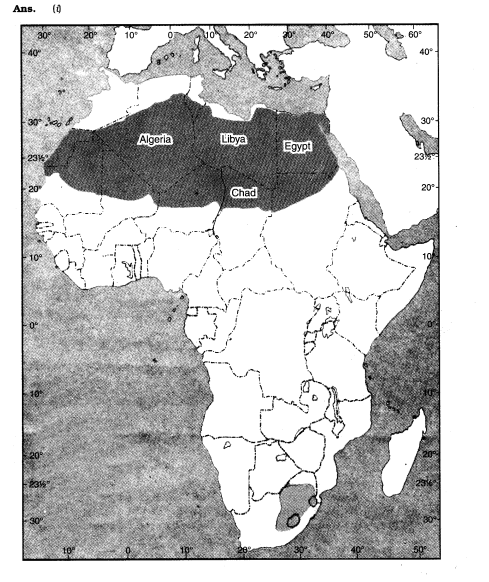
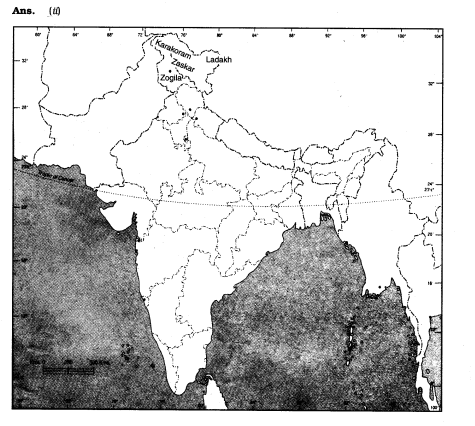
Que: Map skills:
(i) On the outline map of Africa, mark the Sahara desert and any four countries
around it.
(ii) On the outline map of India, mark the Karakoram Range, Zanskar Range,
Ladakh and Zoji La pass.
Ans:
Topic Lists: