

2. Polynomials Mathematics Exercise - 2.3 class 10 Maths in English - CBSE Study
NCERT Solutions for Class 10 Mathematics are carefully prepared according to the latest CBSE syllabus and NCERT textbooks to help students understand every concept clearly. These solutions cover all important 2. Polynomials with detailed explanations and step-by-step answers for better exam preparation. Each Exercise 2.3 is explained in simple language so that students can easily grasp the fundamentals and improve their academic performance. The study material is designed to support daily homework, revision practice, and final exam preparation for Class 10 students. With accurate answers, concept clarity, and structured content, these NCERT solutions help learners build confidence and score higher marks in their examinations. Whether you are revising a specific topic or preparing an entire chapter, this resource provides reliable and syllabus-based guidance for complete success in Mathematics.
Class 10 English Medium Mathematics All Chapters:
2. Polynomials
3. Exercise 2.3
Exercise 2.3 class 10 maths chapter 2. Polynomials
Q1. Divide the polynomial p(x) by the polynomial g(x) and find the quotient and remainder in each of the following:
(i) p(x) = x3 – 3x2 + 5x – 3, g(x) = x2 – 2
(ii) p(x) = x4 – 3x2 + 4x + 5, g(x) = x2 + 1 – x
(iii) p(x) = x4 – 5x + 6, g(x) = 2 – x2
Solution: (i) p(x) = x3 – 3x2 + 5x – 3, g(x) = x2 – 2
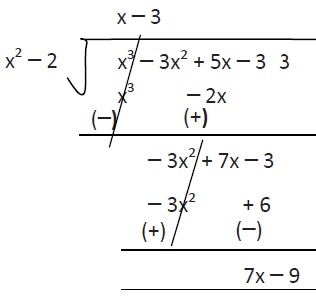
Quotients q(x) = x – 3 and Remainder = 7x – 9
Solution: (ii) p(x) = x4 – 3x2 + 4x + 5, g(x) = x2 + 1 – x
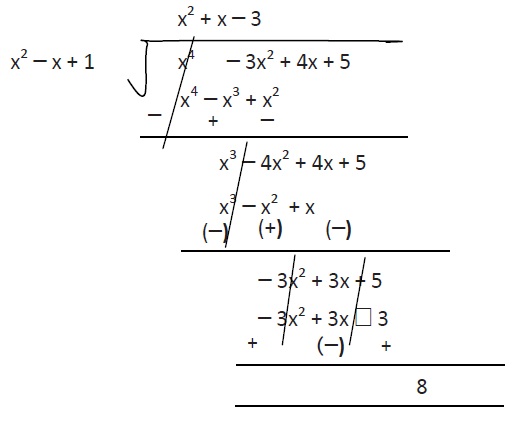
Quotients q(x) = x2 + x – 3 and Remainder = 8
Solution: (iii) p(x) = x4 – 5x + 6, g(x) = 2 – x2
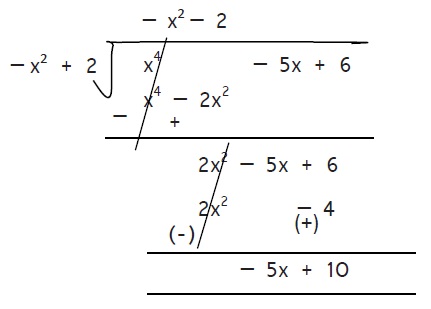
Quotients q(x) = – x2 – 2 and Remainder = – 5x + 10
Q2. Check whether the first polynomial is a factor of the second polynomial by dividing the second polynomial by the first polynomial:
(i) t2 – 3, 2t4 + 3t3 – 2t2 – 9t – 12
(ii) x2 + 3x + 1, 3x4 + 5x3 – 7x2 + 2x + 2
(iii) x3 – 3x + 1, x5 – 4x3 + x2 + 3x + 1
Solution: (i) t2 – 3, 2t4 + 3t3 – 2t2 – 9t – 12
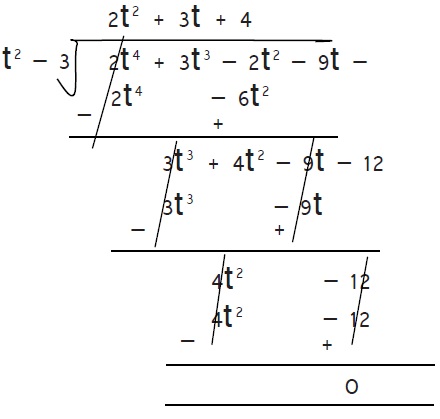
Hence Remainder r(x) is 0
Therefore, t2 – 3 is the factor of 2t4 + 3t3 – 2t2 – 9t – 12
Solution: (ii) x2 + 3x + 1, 3x4 + 5x3 – 7x2 + 2x + 2
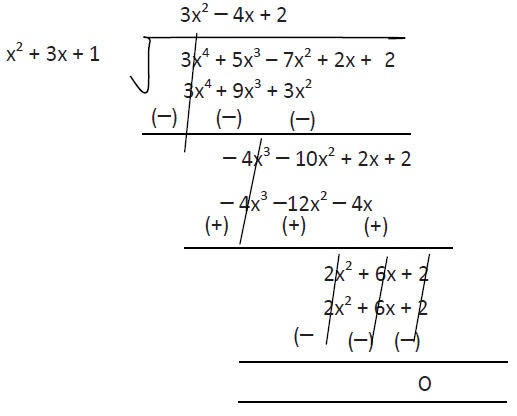
Hence Remainder r(x) is 0
Therefore, x2 + 3x + 1 is the factor of 3x4 + 5x3 – 7x2 + 2x + 2
Solution: (iii) x3 – 3x + 1, x5 – 4x3 + x2 + 3x + 1
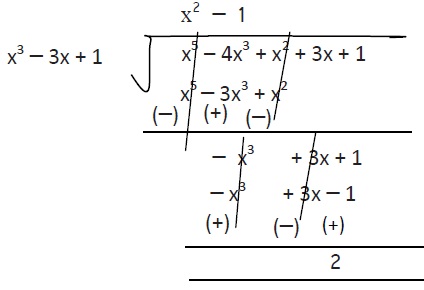
Hence Remainder r(x) = 2
Therefore, x3 – 3x + 1, is not a factor of x5 – 4x3 + x2 + 3x + 1
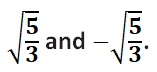
Q3. Obtain all other zeroes of 3x4 + 6x3 – 2x2 – 10x – 5, if two of its zeroes are
Solution:
Given that : p(x) = 3x4 + 6x3 – 2x2 – 10x – 5
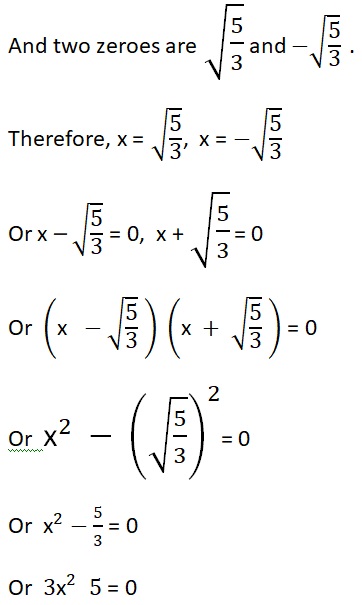
Or 3x2 - 5 = 0
Therefore, 3x2 - 5 is the factor of p(x)
Now Dividing 3x4 + 6x3 - 2x2 - 10x - 5 by 3x2 - 5
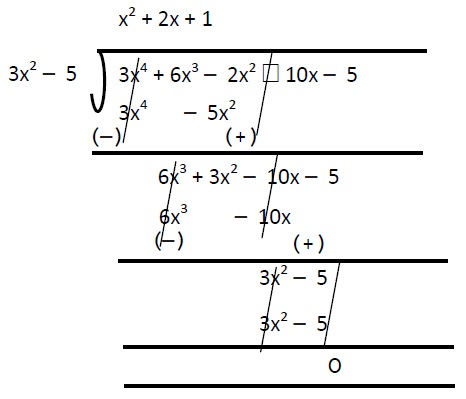
Therefore, p(x) = (3x2 – 5) (x2 + 2x + 1)
Now, factorizing and getting zeroes x2 + 2x + 1 -
= x2 + x + x + 1 = 0
= x(x + 1) + 1(x + 1) = 0
= (x + 1) (x + 1) = 0
Or x + 1 = 0, x + 1 = 0
Or x = – 1, x = – 1
Therefore, two zeroes are – 1 and – 1.
Q4. On dividing x3 – 3x2 + x + 2 by a polynomial g(x), the quotient and remainder were x – 2 and –2x + 4, respectively. Find g(x).
Solution:
Given that: Dividend p(x) = x3 – 3x2 + x + 2
Quotient q(x) = x – 2,
Remainder r(x) = – 2x + 4
Divisor g(x) =?
Dividend = divisor × quotient + remainder
p(x) = g(x) × q(x) + r(x)
x3 – 3x2 + x + 2 = g(x) (x – 2) + (– 2x + 4)
x3 – 3x2 + x + 2 + 2x – 4 = g(x) (x – 2)
g(x) (x – 2) = x3 – 3x2 + 3x – 2
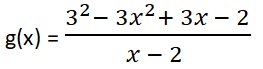
Dividing x3 – 3x2 + 3x – 2 by x - 2 we obtain g(x)-
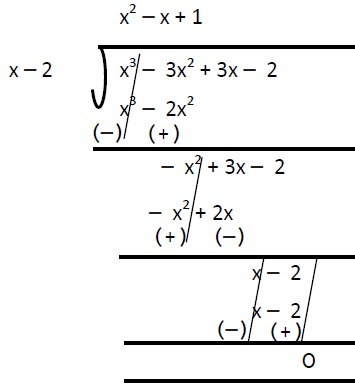
Therefore, Divisor g(x) = x2 – x + 1
Q5. Give examples of polynomials p(x), g(x), q(x) and r(x), which satisfy the division algorithm and
(i) deg p(x) = deg q(x)
(ii) deg q(x) = deg r(x)
(iii) deg r(x) = 0
Solution:
Using Euclid’s Division algorithm:
p(x) = g(x) × q(x) + r(x) where q(x) – 0
(i) deg p(x) = deg q(x)
The deg of dividend p(x) and quotient q(x) can be equal when deg of divisor is 0 or any number.
Example : Let p(x) = 2x2 - 6x + 3
And let g(x) = 2
On dividing
p(x) = 2x2 - 6x + 2 + 1
= 2(x2 - 3x + 1) + 1
Now comparing 2(x2 - 3x + 1) + 1 by p(x) = g(x) × q(x) + r(x) we get:
So, q(x) = x2 - 3x + 1and r(x) = 1
By which we obtain deg p(x) = deg q(x)
(ii) deg q(x) = deg r(x)
Solution: This situation comes when deg p(x) and deg g(x) is equal-
Let p(x) = 2x2 + 6x + 7 and g(x) = x2 + 3x + 2
On dividing: q(x) = 2 and r(x) = 3
Therefore, deg q(x) = deg r(x)
(iii) deg r(x) = 0
Solution:
r(x) = 0 is obtained when p(x) is completely divisible by g(x):
Let p(x) = x2 – 1 and g(x) = x + 1
On dividing we obtain:
q(x) = x – 1 and r(x) = 0
Topic Lists: