

Introduction to Linear Polynomials Class 9 Mathematics Ganita Manjari [LATEST] Solutions End-of-Chapter Exercises in English - CBSE Study
NCERT Solutions for Class 9 Mathematics Ganita Manjari are carefully prepared according to the latest CBSE syllabus and NCERT textbooks to help students understand every concept clearly. These solutions cover all important Introduction to Linear Polynomials with detailed explanations and step-by-step answers for better exam preparation. Each End-of-Chapter Exercises is explained in simple language so that students can easily grasp the fundamentals and improve their academic performance. The study material is designed to support daily homework, revision practice, and final exam preparation for Class 9 students. With accurate answers, concept clarity, and structured content, these NCERT solutions help learners build confidence and score higher marks in their examinations. Whether you are revising a specific topic or preparing an entire chapter, this resource provides reliable and syllabus-based guidance for complete success in Mathematics Ganita Manjari.
Class 9 English Medium Mathematics Ganita Manjari All Chapters:
Introduction to Linear Polynomials
7. End-of-Chapter Exercises
End-of-Chapter Exercises
Q1. Write a polynomial of degree 3 in the variable x, in which the coefficient of the x2 term is –7.
Q2. Find the values of the following polynomials at the indicated values of the variables.
(i) 5x2 – 3x + 7 if x = 1
(ii) 4t3 – t2 + 6 if t = a
Q3. If we multiply a number by 52 and add 23 to the product, we get –7 12. Find the number.
Q4. A positive number is 5 times another number. If 21 is added to both the numbers, then one of the new numbers becomes twice the other new number. What are the numbers?
Q5. If you have `800 and you save `250 every month, find the amount you have after (i) 6 months (ii) 2 years. Express this as a linear pattern.
*Q6. The digits of a two-digit number differ by 3. If the digits are interchanged, and the resulting number is added to the original number, we get 143. Find both the numbers.
*Q7. Draw the graph of the following equations, and identify their slopes and y-intercepts. Also, find the coordinates of the points where these lines cut the y-axis.
(i) y = –3x + 4
(ii) 2y = 4x + 7
(iii) 5y = 6x – 10
(iv) 3y = 6x – 11
Are any of the lines parallel?
*Q8. If the temperature of a liquid can be measured in Kelvin units as x K and in Fahrenheit units as y °F, the relation between the two systems of measurement of temperature is given by the linear
equation y = 95
(x – 273) + 32.
(i) Find the temperature of the liquid in Fahrenheit if the temperature of the liquid is 313 K.
(ii) If the temperature is 158 °F, then find the temperature in Kelvin.
*Q9. The work done by a body on the application of a constant force is the product of the constant force and the distance travelled by the body in the direction of the force. Express this in the form of
a linear equation in two variables (work w and distance d), and draw its graph by taking the constant force as 3 units. What isthe work done when the distance travelled is 2 units? Verify it by
plotting it on the graph.
*Q10. The graph of a linear polynomial p(x) passes through the points (1, 5) and (3, 11).
(i) Find the polynomial p(x).
(ii) Find the coordinates where the graph of p(x) cuts the axes.
(iii) Draw the graph of p(x) and verify your answers.
*Q11. Let p(x) = ax + b and q(x) = cx + d be two linear polynomials
such that:
(i) p(0) = 5.
(ii) The polynomial p(x) – q(x) cuts the x-axis at (3, 0).
(iii) The sum p(x) + q(x) is equal to 6x + 4 for all real x.
Find the polynomials p(x) and q(x).
*Q12. Look at the first three stages of a growing pattern of hexagons made using matchsticks. A new hexagon gets added at every stage which shares a side with the last hexagon of the previous
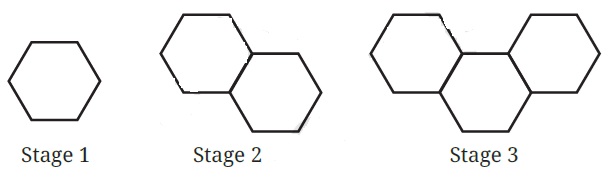
(i) Draw the next two stages of the pattern. How many matchsticks will be required at these stages?
(ii) Complete the following table.

(iii) Find a rule to determine the number of matchsticks required for the nth stage.
(iv) How many matchsticks will be required for the 15th stage of the pattern?
(v) Can 200 matchsticks form a stage in this pattern? Justify your answer.
*Q13. Let p(x) = ax + b and q(x) = cx + d be two linear polynomials such that:
(i) The graph of p(x) passes through the points (2, 3) and (6, 11).
(ii) The graph of q(x) passes through the point (4, –1).
(iii) The graph of q(x) is parallel to the graph of p(x).
Find the polynomials p(x) and q(x). Also, find the coordinates of the point where these lines meet the x-axis.
*Q14. What do all linear functions of the form f(x) = ax + a, a > 0, have in common?
Topic Lists: