

Chapter 3. Motions of the Earth Class 6 Geography [LATEST] Solutions Additional Questions in English - CBSE Study
NCERT Solutions for Class 6 Geography are carefully prepared according to the latest CBSE syllabus and NCERT textbooks to help students understand every concept clearly. These solutions cover all important Chapter 3. Motions of the Earth with detailed explanations and step-by-step answers for better exam preparation. Each Additional Questions is explained in simple language so that students can easily grasp the fundamentals and improve their academic performance. The study material is designed to support daily homework, revision practice, and final exam preparation for Class 6 students. With accurate answers, concept clarity, and structured content, these NCERT solutions help learners build confidence and score higher marks in their examinations. Whether you are revising a specific topic or preparing an entire chapter, this resource provides reliable and syllabus-based guidance for complete success in Geography.
Class 6 English Medium Geography All Chapters:
Chapter 3. Motions of the Earth
3. Additional Questions
Additional Question:
Que: Define the circle of illumination.
Ans: The circle that divides the day from night on the globe is known as the circle of illumination.
Que: Which motion of the earth is associated with the changes in season?
Ans: Revolution.
Que: Why do season change?
Ans: Season change due to the change in the position of the earth around the sun.
Que: Why do the aresa near the ples recevies less heat?
Ans: I t is because the rays of sun are slanting on the poles.
Que: When do the longest day and the shortest night occur in the Northern hemisphere?
Ans: On 21st June.
Que: In which Hemisphere does Australia lie?
Ans: Australia lies in the Southern Hemisphere.
Que: What would happen if the earth did not rotate?
Ans: In such a condition the portion of the earth facing the sun would always experience day, and thus there would be continuous warmth in the region. At the same time, the other half would always remain dark and be freezing cold all the time. These are extreme conditions which are not suitable for life. Thus, we can say that if the earth did not rotate life would not have been poosible.
Que: How does leap year occur?
Ans: The earth taken 36514 days Le. one year to complete one revolution areound the sun. We consider a year as consisting of 365 days only and ignore six hours for our convenience. Six houres saved every year are added to the month of february. Thus every fourth year, February of 29 days instead of 28 days. Such a year with 366 days is called a leap year.
Que: Explain:
(a) summer solstice
(b) Winter solstice
(c) Equinox
Ans:
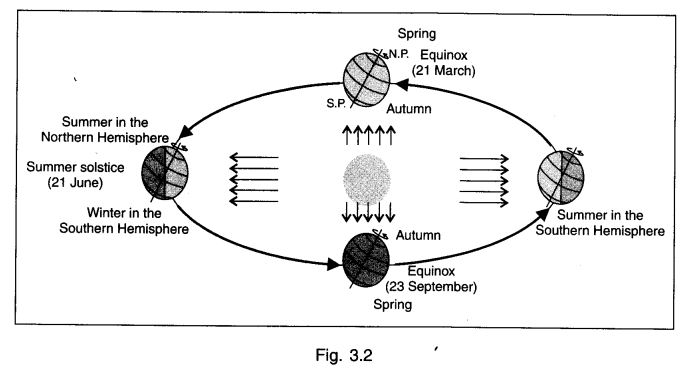
(a) Summer solstice, The Northern Hemisphere is titled towards the sun on 21st June. As the rays of thes sun fall directly on the Tropic of cancer, these areas receive more heat. But the size of the area to the poles receives less heat due to the slanting rays of the sun. The North pole is inclined toward the sun the place beyound the Arctic Circle experience continuous daylight for about six months.
Since a large area of the Northern Hemisphere is getting light from the sun, it is summer in the regions north of the equator. The longest day and the shortest night at these places occur on 21st June. These conditiond are reversed in the Southern Hemisphere at this time. it is winter season there having longer nights and shorter days. This position of the earth is konwn as the summer solstice.
(b) Winter solstice. On 22nd December, the tropic of Capricorn receives direct rays of the as the South pole tilts towards it, As the sun's rays fall vertically at the Tropic of Capricorn, a larger portion of the Southern Hemisphere gets light. hence, the Southern hemisphere enjoys sumer having longer days and shorter nights. This position of the earth is called the winter solstice.
(c) On 21st March and 3rd September direct rays of the sun fall on the equator. At this position, neither of the poles is tilted toward the sun. As a result, the entire earth experiences equal days and equal nights. This phenomenon known as an equinox.
Topic Lists: