

9. Sequences and Series Mathematics Exercise - 9.3 class 11 Maths in English - CBSE Study
NCERT Solutions for Class 11 Mathematics are carefully prepared according to the latest CBSE syllabus and NCERT textbooks to help students understand every concept clearly. These solutions cover all important 9. Sequences and Series with detailed explanations and step-by-step answers for better exam preparation. Each Exercise 9.3 (Available) is explained in simple language so that students can easily grasp the fundamentals and improve their academic performance. The study material is designed to support daily homework, revision practice, and final exam preparation for Class 11 students. With accurate answers, concept clarity, and structured content, these NCERT solutions help learners build confidence and score higher marks in their examinations. Whether you are revising a specific topic or preparing an entire chapter, this resource provides reliable and syllabus-based guidance for complete success in Mathematics.
Class 11 English Medium Mathematics All Chapters:
9. Sequences and Series
3. Exercise 9.3 (Available)


Q13. How many terms of G.P. 3, 32, 33, …. are needed to give the sum 120?

Q14. The sum of first three terms of a G.P. is 16 and the sum of the next three terms is 128. Determine the first term, the common ratio and the sum to n terms of the G.P.
Solution:

Q15. Given a G.P. with a = 729 and 7th term 64, determine S7.
Solution:

Q16. Find a G.P. for which sum of the first two terms is – 4 and the fifth term is 4 times the third term.
Solution:
S2 = - 4,
T5 = 4(T3)

Q17. If the 4th, 10th and 16th terms of a G.P. are x, y and z, respectively. Prove that x, y, z are in G.P.
Solution:
T4 = ar3 = x ------------------ (I)
T10 = ar9 = y ---------------(II)
T16 = ar15 = z ---------------(III)
If T4, T10 and T16 are in G.P then x, y and z also will be in G.P

Q18. Find the sum to n terms of the sequence, 8, 88, 888, 8888… .
Solution:
Let S is the sum of n terms of series;
∴ Sn = 8 + 88 + 888 + 8888 + ………….. to the n term
= 8(1 + 11 + 111 + 1111 + ……….. )


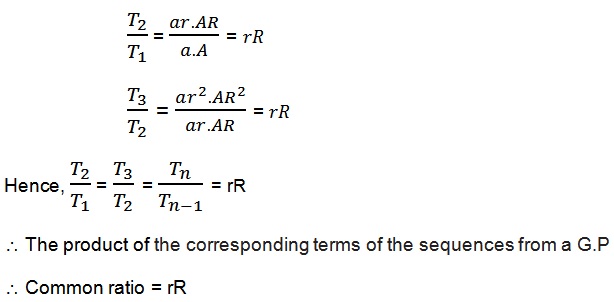
Q20. Show that the products of the corresponding terms of the sequences a, ar, ar2, …arn – 1 and A, AR, AR2, … ARn – 1 form a G.P, and find the common ratio.
Solution:
Product of sequence = a.A, ar.AR, ar2.AR2 ………….. arn -1.ARn -1
Common ratio :
Q21. Find four numbers forming a geometric progression in which the third term is greater than the first term by 9, and the second term is greater than the 4th by 18.
Solution:

Q22. If the pth, qth and rth terms of a G.P. are a, b and c, respectively. Prove that
aq – r br – p cp – q = 1.
Solution:
Let first term be A and common ratio be R.
Tp = ARp – 1 = a -------------- (I)
Tq = ARq – 1 = b -------------- (II)
Tr = ARr – 1 = c --------------- (III)
aq – r . br – p . cp – q = (ARp – 1 )q – r . (ARq – 1)r – p . (ARr – 1)p – q
= AR(p – 1)(q – r ).AR(q – 1)(r – p) . AR(r – 1)(p – q)
= AR(p – 1)(q – r ) + (q – 1)(r – p) + (r – 1)(p – q)
= AR(pq – pr – q + r + qr – pq – r + p + pr – qr – p + q)
= (AR)0
= 1
Q23. If the first and the nth term of a G.P. are a and b, respectively, and if P is the product of n terms, prove that P2 = (ab)n.
Solution:

Q24. Show that the ratio of the sum of first n terms of a G.P. to the sum of terms from (n + 1)th to (2n)th term is 1/rn.
Solution:

Q25. If a, b, c and d are in G.P. show that
(a2 + b2 + c2) (b2 + c2 + d2) = (ab + bc + cd)2.
Solution:
a, b, c, d are in G.P. Therefore,
bc = ad ……………………... (1)
b2 = ac …………………….... (2)
c2 = bd …………………...... (3)
It has to be proved that,
(a2 + b2 + c2) (b2 + c2 + d2) = (ab + bc – cd)2
R.H.S.
= (ab + bc + cd)2
= (ab + ad + cd)2 [Using (1)]
= [ab + d (a + c)]2
= (ab)2 + 2(ab)d(a + c) + [d(a + c)]2
= a2b2 + 2abd (a + c) + d2 (a + c)2
= a2b2 +2a2bd + 2acbd + d2(a2 + 2ac + c2)
[Using (1) and (2)]
= a2b2 + 2a2c2 + 2b2c2 + d2a2 + 2d2b2 + d2c2 [using bc = ad and b2 = ac]
= a2b2 + a2c2 + a2c2 + b2c2 + b2c2 + d2a2 + d2b2 + d2b2 + d2c2
= a2b2 + a2c2 + (ac)2 + b2c2 + b2c2 + a2d2 + (bd)2 × (bd)2 + c2d2
= a2b2 + a2c2 + (b2)2 + b2c2 + b2c2 + a2d2 + (bd)2 × (c2)2 + c2d2
= a2b2 + a2c2 + b2 × b2 + b2c2 + c2b2 + a2d2 + b2d2 + c2 × c2 + c2d2
= a2b2 + a2c2 + a2d2 + b2 × b2 + b2c2 + b2d2 + c2b2 + c2 × c2 + c2d2
[Using (2) and (3) and rearranging terms]
= a2(b2 + c2 + d2) + b2 (b2 + c2 + d2) + c2 (b2+ c2 + d2)
= (a2 + b2 + c2) (b2 + c2 + d2) = L.H.S.
∴ L.H.S. = R.H.S.
∴ (a2 + b2 + c2) (b2 + c2 + d2) = (ab + bc – cd)2
Q26. Insert two numbers between 3 and 81 so that the resulting sequence is G.P.
Solution:
Let G1, G2 be three numbers between 3 and 81 such that 3, G1, G2, 81 is a G.P
T1 = 3
T2 = ar
T3 = ar2
T4 = ar3 = 81
3.r3 = 81
r3 =
r3 = 27

For r = 3, we have
T2 = ar = 3.3 = 9
T3 = ar2 = 3.32 = 27


Q28. The sum of two numbers is 6 times their geometric mean, show that numbers are in the ratio (3 + 2√2) : (3 − 2√2).
Solution:
Let the numbers be a and b.


Topic Lists: