

2. Linear Equations in One Variable Mathematics Exercise - 2.2 class 8 Maths in English - CBSE Study
NCERT Solutions for Class 8 Mathematics are carefully prepared according to the latest CBSE syllabus and NCERT textbooks to help students understand every concept clearly. These solutions cover all important 2. Linear Equations in One Variable with detailed explanations and step-by-step answers for better exam preparation. Each Exercise 2.2 is explained in simple language so that students can easily grasp the fundamentals and improve their academic performance. The study material is designed to support daily homework, revision practice, and final exam preparation for Class 8 students. With accurate answers, concept clarity, and structured content, these NCERT solutions help learners build confidence and score higher marks in their examinations. Whether you are revising a specific topic or preparing an entire chapter, this resource provides reliable and syllabus-based guidance for complete success in Mathematics.
Class 8 English Medium Mathematics All Chapters:
2. Linear Equations in One Variable
2. Exercise 2.2
Exercise 2.2
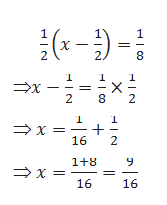
Q1. If you subtract from a number and multiply the result by , you get . What is the number?
Solution:
Let the number be x
so, the equation will be
Q2. The perimeter of a rectangular swimming pool is 154 m. Its length is 2 m more than twice its breadth. What are the length and the breadth of the pool?
Solution:
Let the breadth of the swimming pool x.
So, the equation will be 

so, the length of pool 2x + 2
= 2×25 + 2
= 50 + 2
= 52
and the breadth of pool x = 25
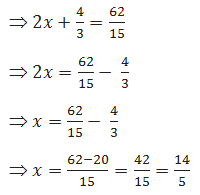
Q3. The base of an isosceles triangle cm the perimeter of a triangle is 4 cm what is the length of either remaining equal sides?
Solution:
Let the length of one remaining equal sides x.So, equation wil 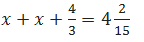
Q4. Sum of two numbers is 95. If one exceeds the other by 15, find the numbers.
Solution:
Let the second number is x.
So, the equation will be x + x + 15 = 95
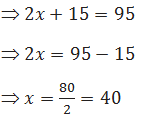
So, the first number will be x + 15
= 40 + 15
= 55
And second number: x = 40
Q5. Two numbers are in the ratio 5:3. If they differ by 18, what are the numbers?
Solution:
Let,
Both numbers will be 5x and 3x
So, the equation will be 5x - 3x = 18
⇒2x = 18

so, the first number will be 5x
= 5 × 9
= 45
and the second number will be = 3 × 9
= 27
Q6. Three consecutive integers add up to 51. What are these integers?
Solution:
Let, all numbers x, x+1, x+2 respectively.
So, the equation will be x+x+1+x+2=51
⇒ 3x +3=51
⇒ 3x=51-3
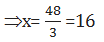
So, the first number will be x = 16
, second number will be x + 1
= 16 + 1
= 17
and the third number will be x + 2 = 18
Q7. The sum of three consecutive multiples of 8 is 888. Find the multiples?
Solution:
Let, three consecutive multiples of 8 is x, x+8, and x+16 respectively
So, the equations will be : x + x + 8 + x + 16 = 888
⇒ 3x + 24 = 888
⇒ 3x = 888 - 24
So, the first multiple x = 288
Second multiple x + 8 = 288+8 = 296
Third multiple x + 16 = 288 + 16 = 304
Q8. Three consecutive integers are such that when they are taken in increasing order and multiplied by 2, 3 and 4 respectively, they add up to 74. Find these numbers.
Solution:
Let, all numbers be x, x+1, x+2
So, the equation will be: 2(x) + 3(x+1) +4(x+2) =74
⇒ 2x+ 3x+3+ 4x+8 = 74
⇒ 9x+11=74
⇒ 9x=74-11

So, first number is x = 7
Second number is x + 1
= 7 + 1 = 8
Third number is x + 2
= 7 + 2
= 9
Q9. The ages of Rahul and Haroon are in the ratio 5:7. Four years later the sum of their ages will be 56 years. What are their present ages?
Solution:
Let, the present ages of Rahul and Haroon be 5x and 7x respectively
So, the equation will be 5x + 4 + 7x + 4 = 56
⇒ 12x + 8 = 56
⇒ 12x = 56 - 8

So, the present age of Rahul: 5x = 5 × 4 = 20
The present age of Haroon: 7x = 7 × 4 = 28
Q10. Aman’s age is three times his son’s age. Ten years ago he was five times his son’s age. Find their present ages.
Solution:
Let, the age of Aman’s son x
⇒5(x - 10) = 3x - 10
⇒ 5x – 50 = 3x - 10
⇒5x – 3x = -10 + 50
⇒2x = 40
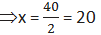
The present age of Aman: 3x = 3 × 20 = 60
The present age of his son: x = 20
Topic Lists: